
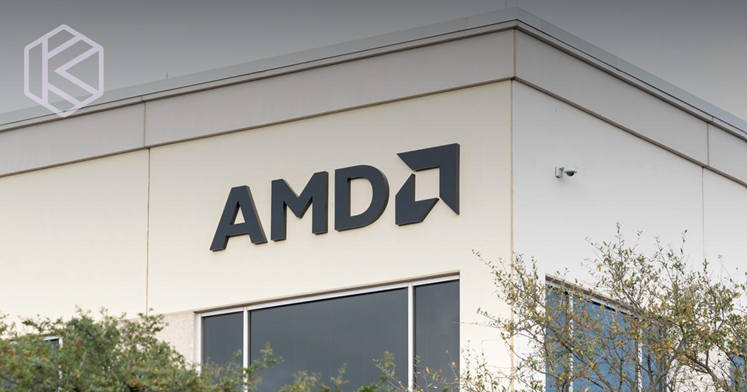
Advanced Micro Devices joins the trillion-dollar chipmaker tier as data centre revenue more than doubles year on year and agentic AI lifts processor demand, while a rich forward multiple and wide analyst targets test concentrated holdings
Advanced Micro Devices crosses the $1 trillion market capitalisation mark for the first time this week, capping a five-session rally of roughly 24%. The advance lifts the stock to a record intraday high of about $588 and places the chipmaker alongside Nvidia, TSMC, Broadcom, SK hynix and Micron in a tier shaped by artificial intelligence demand. Kinzey Capital Management Pte. Ltd. frames what the milestone means for portfolios carrying chipmaker exposure.
The rally also carries the stock through a price just above $572, a level that matters to two of the best-known names in AI. Meta Platforms and OpenAI currently hold warrants for up to 320 million AMD shares with final tranches tied to that threshold, positioning both as potential major shareholders. The shares now stand more than 180% above their level at the turn of the year, against roughly 13% for the S&P 500 over the same stretch.
Demand signals from consumer software supply the immediate catalyst, with Meta’s AI agent Muse reaching the top of Apple’s US App Store. Traders read that uptake as evidence that inference will draw far more central processors alongside graphics chips. Intel chief executive Lip-Bu Tan, speaking at the Splunk conference in Denver, says CPU demand runs so high that the company can supply only 50% of its customers at present.
Trading at the start of the week shows how quickly that conviction travels, with AMD rising 9.6% in one session before slipping back below $1 trillion. In the same session, Intel gains around 11%, Qualcomm adds 4.1% and the chips index climbs 2.6% to a one-month high. The swings reflect profit-taking meeting fresh entry as the capitalisation crosses and recrosses the line.
The valuation looks less stretched against AMD’s own history than against its peers, at roughly 41 times earnings expected over the coming year. That multiple sits below the 44 times the stock has averaged over the past decade. On forward earnings, Nvidia trades at 16.3 times and Broadcom at approximately 21 times, a gap that reflects the premium investors assign AMD for anticipated AI growth, with execution risk priced in.
That premium turns the milestone into a question of capacity for portfolios already holding the stock, since the valuation embeds substantial future growth. The round number matters less to holders than execution against entrenched rivals, which shows up quarter by quarter. The price amounts to “a claim on artificial intelligence demand that data centre momentum still has to convert into sustained market share gains”, in the assessment of Kinzey Capital Management’s Director of Private Clients, David Nilson.
Volatility sharpens that question for capital that may be called on, because AMD carries a beta of 2.48 on current readings. Regulatory disclosures show chief executive Lisa Su trimming her personal holdings into the advance, although the latest balance sheet stays conservative with a debt-to-equity ratio of 0.03. Analyst targets run from a consensus near $539 for the coming year to a bullish case of almost $1,193 tied to multi-gigawatt order ramps through the coming quarters, a spread of roughly $650.
Nvidia still dwarfs the tier’s newest member, with a market capitalisation of approximately $5.2 trillion, now more than five times AMD’s level. That lead rests on data centre GPUs for training large language models, where Nvidia held roughly 90% of the addressable market through last year. On current figures, Intel holds 63.3% of the server CPU market against AMD’s 36.5%, yet carries a market capitalisation of roughly $641 billion.
Data centre revenue remains the engine behind the rerating, reaching $6.4 billion in the most recent quarter on demand for EPYC processors and Instinct GPUs. That figure is up 107% on the comparable quarter a year earlier and equals 58% of total revenue. AMD has lifted its forecast for annual server CPU market growth over the next three to five years to 35% from 18%, and expects data centre revenue to more than double next year.
Kinzey Capital Management reads the milestone as a measure of investor confidence in AI infrastructure demand, set against execution risk the valuation already prices in. Agentic workloads widen the market for CPU and GPU capacity together, but whether AMD captures enough of that ground to hold its multiple remains open. Nilson frames the portfolio question around purpose, noting that “the duty behind the capital, not the headline number, decides how much of that uncertainty a portfolio can carry”.
Kinzey Capital Management, on the Record
Singapore-based Kinzey Capital Management oversees discretionary multi-asset portfolios for private clients, businesses, families and foundations, managing equities, bonds, funds and cash as one book. Each portfolio is shaped by what its capital must do, when it may be needed and how much movement it can absorb, with instruments chosen to match.
Growth Portfolios, Income and Withdrawals, Corporate Reserves and Joint and Family Accounts continue until the underlying obligation ends, whereas Concentrated Shareholdings and Second-Opinion Reviews are one-off engagements around existing holdings. Reporting tracks each portfolio against its assigned obligation.
Kinzey Capital Management Pte. Ltd. is registered under UEN 202105652G, with further information at https://kinzey.com. Media enquiries should be addressed to Chloe Lim at c.lim@kinzey.com.